Missiles for the Pacific: Why the Royal Navy Needs ‘Arsenal Ships’

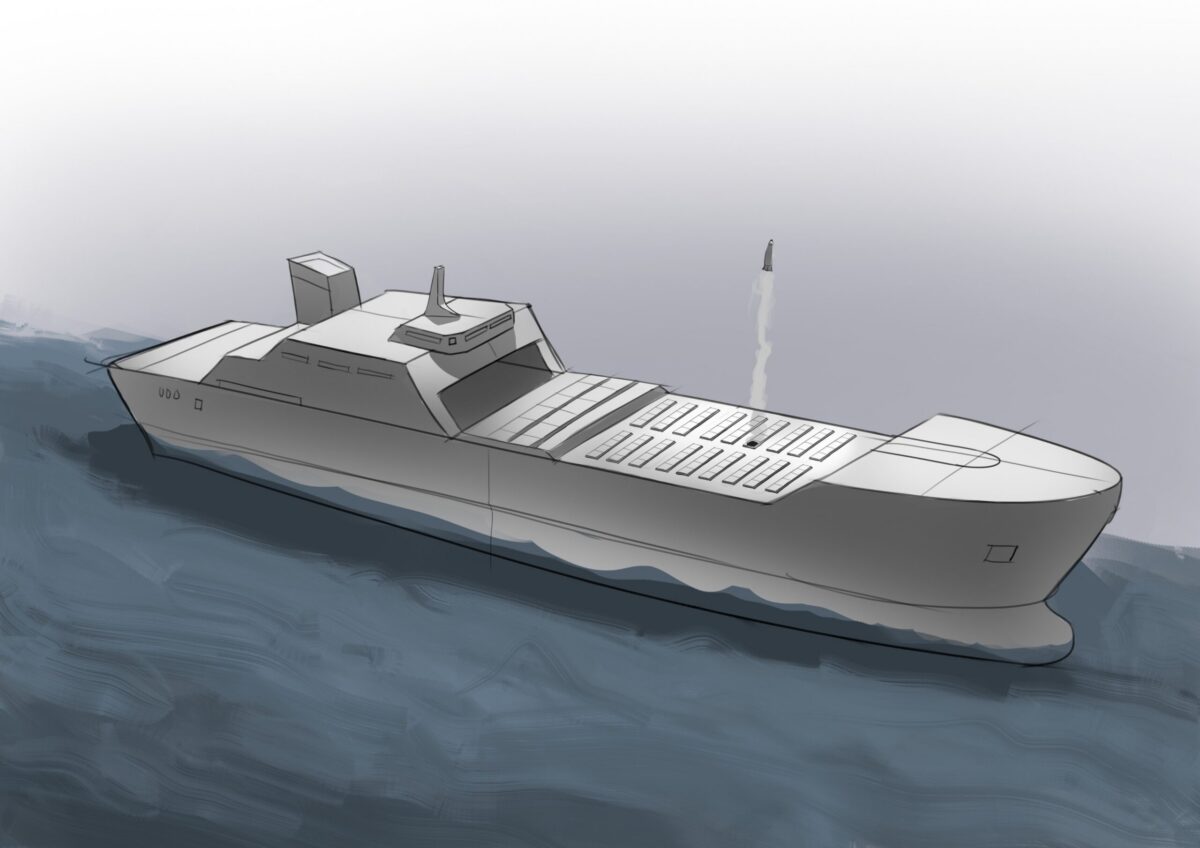
I was stuck waiting for the Isle of Wight ferry at Portsmouth last summer, nursing a cup of lukewarm terminal coffee and staring out at the Solent. Just drifting past the Spinnaker Tower was this absolute beast of a container ship. It was stacked high with those multi-coloured metal boxes, probably full of air fryers and fast fashion destined for a warehouse in the Midlands.
Watching it lumber past, it struck me that we are missing a massive trick. You could fit a terrifying amount of military kit on a deck that size, and frankly, I don’t understand why the Royal Navy isn’t already doing it.
We need to be honest about the maths here. Modern naval warfare isn’t just about who has the cleverest radar or the bravest crew; it is about algebra. Strategists call it the “salvo equation.”
In a hypothetical scrap with a peer adversary like China, victory isn’t about finesse; it’s about volume. It goes to the side that can put the most missiles in the air at once. And right now, the numbers aren’t in our favour.

The Brutal Arithmetic
Our Type 45 destroyers are arguably the best air-defence ships on the planet. They are incredible machines. But they only carry 48 missiles. Meanwhile, China’s Type 055 cruisers pack 112 vertical launch cells each.
In a straight fight, they can simply out-barrage us. It’s a saturation effect that is going to be extremely difficult to overcome. We would run out of ammo long before they ran out of targets.
So, how do we fix it? The answer isn’t to bankrupt the Treasury by building dozens more high-tech destroyers. The answer is to decouple the magazine from the radar.
Enter the ‘Floating Magazine’
We need to take those merchant hull designs—or even convert existing commercial vessels—and turn them into “Arsenal Ships“.
Now, I’m not talking about sending these ships off on solo missions to play pirate in the shipping lanes or hiding them in “Grey Zone” scenarios. That puts civilian sailors at risk and is a strategic nightmare. In a real shooting war, these ships wouldn’t be hiding. They would be right in the middle of the fleet.
Think of them as a “High Value Unit” sitting well back in the formation alongside the Queen Elizabeth-class carriers, protected by a screen of Type 26 frigates and Astute-class submarines.
The Arsenal Ship acts as the fleet’s goalkeeper and its heavy hitter. It is a floating warehouse, packed with hundreds of missile cells, waiting for a command from the frontline ships to unleash hell.
The Invisible String: Any Sensor, Any Shooter
The beauty of this concept is that the Arsenal Ship doesn’t need to see the target to hit it. It effectively shoots “blind,” relying on a concept the military calls Cooperative Engagement Capability (CEC).
Think of it like using Uber: the car (the missile) doesn’t need to know the destination until the app (the sensor) tells it where to go. The Arsenal Ship is just the taxi rank; the instructions come from elsewhere.
- The F-35 Factor: An F-35B Lightning II could be flying hundreds of miles ahead, totally silent. It spots an enemy fleet using its advanced sensors. Instead of engaging and revealing its position, it beams the data back to the Arsenal Ship via secure datalinks. The ship fires, and the F-35 guides the missile in for the kill.
- Drone Eyes: For land attacks, a small, stealthy drone or a Special Forces team on the ground could paint a target. They send the coordinates up the chain, and the Arsenal Ship launches a precision strike without ever turning on a radar.
- The Radar Shield: Our Type 45 Destroyers can sit at the front of the fleet, using their massive Sampson radars to track incoming aerial threats. They then “borrow” the missiles from the Arsenal Ship at the back of the fleet to intercept them.
This network allows the “dumb” ship to fight with the situation awareness of the entire fleet.
Bringing the Mass
This setup changes the maths completely. If we had just two converted merchant hulls in a task group, each carrying 100+ missiles, we could match the enemy’s barrage volume without risking our expensive destroyers. We could pack them with a mix of everything:
Land Attack: The Heavy Hitters
This is where the Arsenal Ship truly shines. It allows us to carry the bulk needed for sustained campaigns.
- Project Nightfall (~600km+): This is the game changer.1 Recently announced, Nightfall is the UK’s new sovereign Tactical Ballistic Missile (TBM).2 Unlike the exquisite and expensive Tomahawk, Nightfall is designed to be “cheap and cheerful” (relatively speaking, at ~£500k a pop) and compact enough to fit standard shipping containers. It allows us to fire in mass volleys to overwhelm defences—perfect for a converted merchant hull targeting coordinates provided by drones.
- Tomahawk Block V (~1,600km): The gold standard. Expensive, but offers massive range for surgical strikes.
- MdCN (~1,400km): The French naval cruise missile, offering a stealthy, deep-strike alternative.
Anti-Ship: The Sea Denial
To keep the enemy surface groups at bay, we load up with next-gen killers.
- FC/ASW (~300km+): The future Anglo-French stealth missile (expected 2030s) designed to slip through radar nets.
- NSM / MOSS (~185km): The Naval Strike Missile (designated MOSS in the UK). Intelligent, sea-skimming, and incredibly difficult to detect.
- RBS15 Mk3 (>300km): A heavy-hitting Swedish design perfect for complex littoral waters.
Anti-Air: The Wall of Steel
Using “mushroom farms” of CAMM launchers (so-called for their capped silos), we can create layers of defence. Because CAMM uses “Soft Vertical Launch” (a piston ejects the missile before the motor fires), there’s no deck-melting exhaust, making it easy to fit on commercial decks.
- CAMM-MR (>100km): A new concept to push our defensive bubble out to over 60 miles.
- CAMM-ER (>45km): Extended range for local area defence.
- CAMM (>25km): The standard Sea Ceptor. The final, agile goalkeeper against leakers.
The Bottom Line
It really does come down to the arithmetic of attrition. If we can’t match the enemy’s volume of fire, we lose. But if we can bring a “missile barge” to the fight—a cheap, deep magazine that sits safely behind the defensive line—we force the enemy to rethink their entire strategy.
We have the missiles—from the high-tech FC/ASW to the mass-volume Project Nightfall. We have the shipyards to convert the hulls. We just need the imagination to realise that in the next war, a converted merchant ship might be the most dangerous thing afloat.