The New Yeomanry: Why Britain Needs a Modern Regional Militia for National Resilience

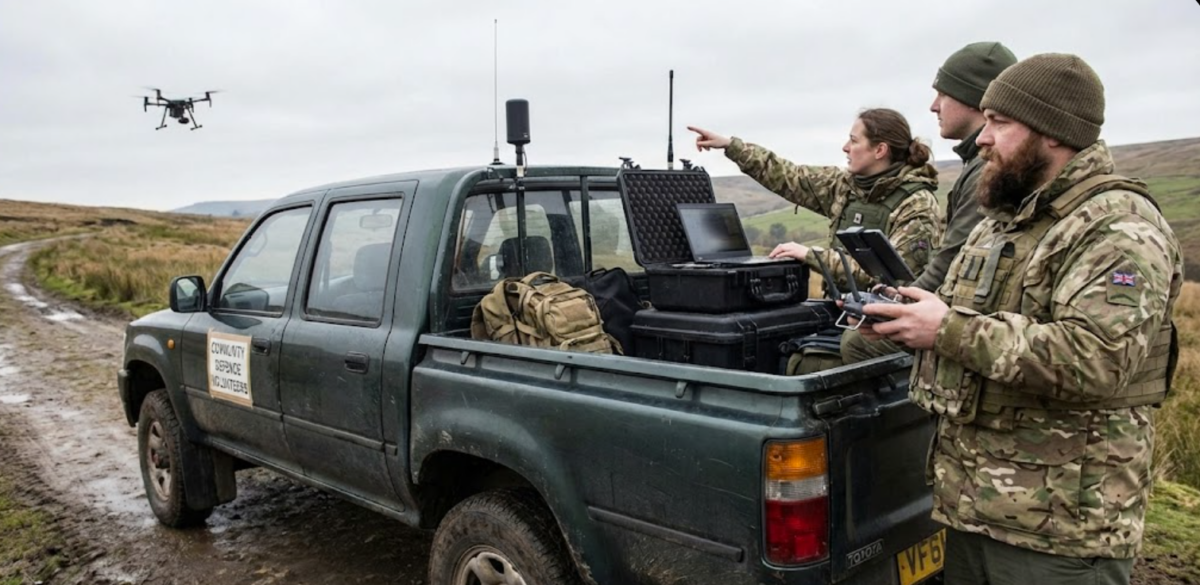
The world has changed. The comfortable assumption that major conflicts happen “over there” has been shattered by the realities of modern warfare in Ukraine. We have seen that in a peer-to-peer conflict, the front line isn’t just a trench in the Donbas; it is a server room in London, a substation in the Midlands, or a reservoir in Wales.
The British Army is highly professional, lethal, and currently, very small. Its primary job is to project force abroad alongside our NATO allies. But if the entirety of our Army is deployed, who is minding the shop back home?
It is time to revive an old concept for a new age. We need to plug the strategic gap in our homeland defence. We don’t need a “Dad’s Army” re-enactment, we need a highly skilled, technologically adept, locally rooted Regional Militia.
Here is a blueprint for how a modern UK Home Service Force a true County Militia should actually work.
Reclaiming the Word “Militia”
Let’s deal with the elephant in the room. The word “militia” often conjures images of unregulated, amateur groups in the US. We need to reclaim its historical British meaning: a constitutionally established, locally raised reserve force dedicated to home defence.
A modern UK Militia would not be a vigilante group. It would be a uniformed, disciplined component of the Ministry of Defence, subject to military law, but with a distinct ethos: Local Knowledge, Local Defence, National Resilience.
Unlike the Regular Army Reserve, which is designed to deploy overseas, the Militia’s primary theatre of operations is their own county. They are the shield, allowing the Regulars to be the sword.
The Composition: Not Just Bayonets, But Bandwidth
The threat landscape has shifted. Therefore, a modern Militia cannot just be infantry. It needs a hybrid structure, blending military discipline with high-level civilian expertise.
We need to recruit three distinct streams of personnel into these regional battalions:
The Military Backbone: Ex-Regulars and Reservists
There is a vast untapped reservoir of veterans in the UK who have “done their time” and do not meet the requirements of the Army Reserve, but still possess valuable skills. Their role is command, planning, and ensuring the Militia runs with discipline.
The Infrastructure Guardians: CNI Experts & Engineers

Modern warfare targets Critical National Infrastructure (CNI). We need the people who build and maintain the systems that keep Britain running.
- Power & Water Specialists: Grid engineers who know how to reroute power during a blackout.
- Civil Engineering & Plant Operators: If a bridge is blown, we need heavy plant operators to clear routes.
Crucially, this force must adopt a “Distributed Engineering” doctrine. Lessons from Ukraine show that large engineering vehicles are priority targets for enemy drones. Therefore, this Militia would rely on widespread civilian equipment specifically miniaturised plant machinery.
- The “Bobcat” Strategy: Instead of relying on a few massive Royal Engineer bulldozers (which are more easily spotted and destroyed), the Militia would utilise hundreds of commercially available mini-diggers, skid-steers, and compact tractors.
- Replaceability: This equipment can be found in almost every town, easy to hide in garages or barns, and if one is destroyed by a drone, it can be replaced by another from a local hire shop within hours or sourced via logistics request but these use a smaller footprint to their larger equivalents.
The Anti-Drone “Mobile Fire Groups”

The single biggest threat to the UK homeland is now the cheap, long-range attack drone. The Militia would be our primary Counter UAS (Unmanned Aerial System) force.
- The Vehicles: We cannot wait for expensive military procurement. These units would utilise high-mobility Commercial Off-The-Shelf (COTS) vehicles robust 4×4 pickups and utility vehicles.
- Survivability: These would not be “soft-skinned.” They would be retrofitted with lightweight, modular up-armouring such as composite lining and slat armour (cages) specifically designed to ensure the crew survives 1-2 direct hits from “kamikaze” drones.
- The Role: These highly mobile teams would patrol the perimeters of key sites (airports, power stations), equipped with electronic jammers and kinetic interceptors (e.g., automated shotguns or light cannons) to hunt down enemy drones before they strike.
The Tech Specialists: Cyber, Comms, and Drones
- Cyber/EW Specialists: IT professionals operating as local “Cyber Defence Cells.”
- The “Drone Cavalry”: Skilled civilian drone pilots from regional hobby groups, recruited to provide cheap ISR (Intelligence, Surveillance, Reconnaissance) or operate “hunter killer” drones against enemy saboteurs.
How It Would Work: The “Elastic Defence”

The defining characteristic of this Militia is its regional focus. A unit based in Newcastle trains to protect Tyneside. They know the terrain, the back roads, the choke points, and the vulnerabilities of their local infrastructure better than any unit deployed from Salisbury Plain ever could.
Peacetime Role: A low-commitment retainer system. Training focuses on knowing their local patch, integrating with local emergency services (blue light services) but also local Army Reserve, and maintaining vehicle and equipment readiness.
Crisis Role (Tier 1 – Local Activation): In the event of a national emergency, Regional Commands can activate local Militia units. Their job is immediate stabilisation, guarding key sites, manning checkpoints, and deploying mobile anti-drone teams to shield the area.
Crisis Role (Tier 2 – National Mobilisation): While their primary role is local, these units must be interoperable. If the south coast ports face a concentrated campaign of sabotage, Militia units from other areas could mobilise their up-armoured COTS fleets and mini-engineering plant equipment to reinforce the area and other units to assist in hunting down the sabotage units.
The Missing Links: Other Vital Specialists
To build a true “whole-of-society” defence force, we must also recruit:
- Medical Trauma Response: Paramedics and combat medics to run forward triage centres when hospitals are overwhelmed.
- Logistics and Haulage Experts: HGV drivers and supply chain experts who master “last mile” delivery when main routes are compromised.
- Farmers and Landowners: They possess the heavy machinery and the intimate knowledge of the rural landscape drainage ditches and farm tracks vital for hiding our dispersed forces.
Conclusion:
A modern Militia is not an admission of weakness, it is a statement of national maturity. It recognises that in the 21st century, resilience is not just the job of the professional soldier, but the duty of the skilled citizen.
By combining the discipline of veterans with the technical expertise of our civilian workforce and equipping them with agile, survivable kit we can create a formidable defensive layer that ensures if the worst happens, Britain can take a punch and keep standing.